Project Specs
· Ceiling, Bathrooms and Kitchen
· Kitchen, Art Gallery, Equipment
· Lighting, Interior, Fixtures
· Walls, Shop, along Studio / Art Gallery
· Stair Railing, Delmar Boulevard
· Glass, Exterior Door and Transom Window
· Lighting, Exterior, Fixtures
· Sidewalks, Fencing, and Landscaping
Interior Specs
· Bathrooms, Accessible
- Use a 6’ 8” deep x 7’ 3” wide accessible bathroom layout with a floor drain 12” x 12” from one corner. This allows installation of an optional future corner shower, or a small claw foot tub installed at a 45 degree angle, simply by repurposing the floor drain.
· Borrowlights
- Install (a) 8’ high x 5’ sliding glass windows in a five (5) panel, three (3) track pattern for the loft studio (left), from Sliding Glass Door Company, and (b) 16” high x 20” wide windows in a nine (9) pane pattern for the gallery office (right)
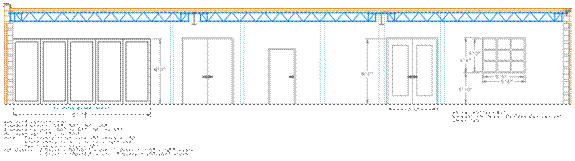
Figure 1 - Borrowlight Concept
- Paint the art gallery closet double-doors, and the art gallery kitchen door, semi-gloss City Loft white in order to de-emphasize these doors
· Ceiling, Art Gallery
- Clean bar joists by vacuuming, dusting with compressed air, washing with TSP, and power washing clean using a brush attachment on the power washer.
- Brush bar joists black Alkyd Industrial Enamel.
- Clean gypsum decking by vacuuming.
- Spray paint ceiling Sherwin-Williams aubergine, a dark purplish color, with an eggshell finish
- Design Note: Dark colors recede, light colors come forward. With a relatively low ceiling, dark colors make the ceiling disappear
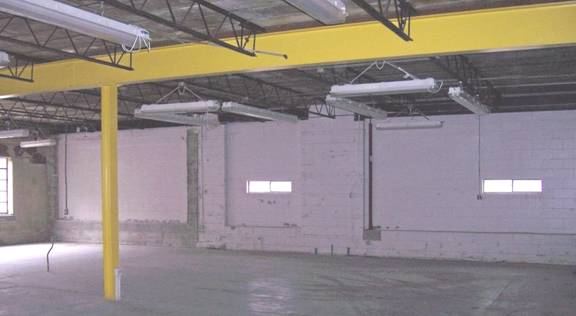
Figure 2 - Bar Joists and Ceiling, and Art Gallery Walls
· Ceiling, Bathrooms and Kitchen
- Option 1: Consider a design detail for a suspended Acoustic Ceiling Tile (ACT), which allows for conversion to a suspended ceiling of corrugated metal which allows for indirect lighting of an interior room. The Acoustic Ceiling Tile (ACT) suspended ceiling becomes a soffit beneath bar joists, forming a visual barrier when looking up between the wall and the suspended corrugated metal ceiling
n The suspended acoustic tile ceiling finishes the room quickly…
n The suspended corrugated metal ceiling adds a design touch later…

Figure 3 - Detail for a Suspended Corrugated Metal Ceiling (12DEC07-WED)
· Darkroom
- Per discussions with darkroom owner Fred Heidolph on 1MAY07, the darkroom should be as large as possible. A deep sink, such as a janitorial sink, works very well. The sink should be stainless steel. Separating the janitorial closet and darkroom is strongly advised against; the suspicion is that the room will be used exclusively as a darkroom.
- Discussion: Keep the darkroom clean by separating the janitorial closet and darkroom. The mops sink is thus located in the kitchen.
- Design Note: Plumb for a commode, allowing the darkroom to convert to an additional women’s room to accommodate future expansion.
· Doors, Interior
- Doors should open 180o where feasible to allow unobstructed access
- Double doors opening to art gallery should contain glass to act as borrowlights
- Open doors should not be visible through the borrowlights
- Single doors to offices, bathrooms, and kitchenette should be commercial solid core doors. Consider a prefinished maple
- Paint metal double doors Sherwin-Williams Naturel (light green), and trim Sherwin-Williams Mountain Road (dark green), with a semi-gloss finish
- Double doors which forklift, man-lift, and art will pass through should be metal so that they withstand a certain amount of abuse
- Double doors should have swing clear hinges allowing the doors to open full width of the door jambs
· Drywall
- Raise bottom of drywall ½” above exposed floor using plastic spacer. This avoids spilled liquids from rusting steel studs.
- Epoxy bolts to floor, when securing base rail of steel stud walls to concrete floor.
- Slip Track - Double top rail, where upper rail is fixed to gypsum decking, and lower rail rides freely inside upper rail, allows roof to flex without cracking drywall.
- http://www.dietrichmetalframing.com/
- http://www.amazon.com/Commercial-Metal-Stud-Framing-Clark/dp/157218079X
- Vinyl Base – Eliminating vinyl base, in line with the gallery tradition of no base, would not sufficiently protect the walls. Recommend going with vinyl base.
· Floors
- Mudjacking - Dust puffs up from the concrete floor joints when forklifts cross the slab corners. The concrete floor should probably be mudjacked to stabilize.
- Staining - Stain existing concrete art gallery floors black. Clean floor via shot peening. Stain with industrial concrete stain
- Tiling - Tile kitchenette with a quarry tile 8” x 8”. Tile gallery kitchen, bathroom, and darkroom floors with a ceramic tile 8” x 8”
- Ceramic Tile - Ceramic tile is made from clay or other minerals. The extruded material is shaped and heat-treated (fired) in a kiln. Clay tiles are then further treated in one of two ways:
· Glazed — color is added to the tile after firing. The glasslike surface is bonded to the tile. Glazing allows brighter colors to be used and adds stain resistance. Because of their slick, glassy surface, glazed tiles are used mostly on walls or countertops. Glazed tile offers more color choices than unglazed.
· Unglazed — (Also called quarry tiles). The pigment or natural color is present during firing and is part of the tile itself. Unglazed tile needs sealing for stain resistance.
- Quarry Tile - Quarry tile is unglazed and requires sealing in wet areas. Clay-based quarry tile is used extensively in commercial settings. Because it's a durable and relatively inexpensive material, it's becoming more acceptable in homes. The predominant colors are earth shades of red and orange.
· HVAC
o Consider separate HVAC zones for the Residential Loft, Art Gallery, and Office. Consider rooftop HVAC to maximize interior space for art gallery and loft.
o Consider heating only in manufacturing area. Consider gas fired unit heaters (GFUHs) in the manufacturing space. Install new suspended GFUHs as the existing 20 year old GFUHs are inefficient and outdated.
o Need recommendation on HVAC consultant. Coordinate with HVAC contractor on zoning, location, and capacity.
o Ensure HVAC has a fan only cycle for gallery ventilation.
· Kitchen, Art Gallery, Equipment
- Review kitchen handwash sink location with restaurant equipment supplier.
- Consider used equipment from Ford Hotel Supply Co., 2204 North Broadway, St. Louis, MO 63102. Website: www.fordstl.com
- Consider new equipment from The Viking Store, 1811 South Brentwood Blvd., St. Louis, MO 63144, 314-961-1999. Website: www.vikingrange.com
- Consider new equipment from Restaurant Depot, 6455 Manchester Ave, Saint Louis, MO 63139, (314) 644-3810. Website: www.restaurantdepot.com
- Don’t consider used equipment from Stern Food Service Equipment and Furnishings, 1910 Locust St., St. Louis, MO 63103. Stern Fixture Co., a downtown manufacturer and distributor of furniture and fixtures used in restaurants, recently turned over its assets to National City Bank. Its ovens and ranges, bar stools and benches, refrigerators and freezers, and chairs and tables will be sold at public auction Sept. 28, 2006. Paradowski Graphic Design is moving to the former Stern Fixture building complex at 20th and Locust.
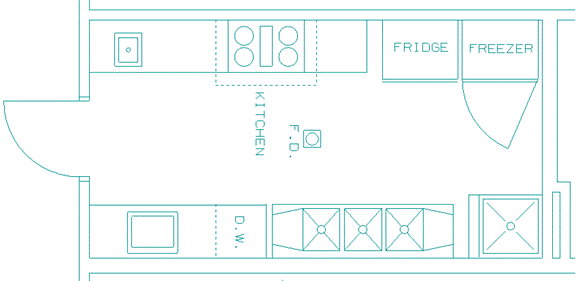
Figure 4 - Kitchen, Art Gallery, Equipment
- Consider Eagle T3072SE-FM-PL Worktables w/ Overshelf Kit, $1382.30, www.restaurantequipment.net. Description: Spec-Master® Work Table, 30"W top, without splash, 72"L, w/fixed s/s legs and undershelf, 14 ga, type 304 s/s top, includes two overshelves and two pot racks, s/s feet.
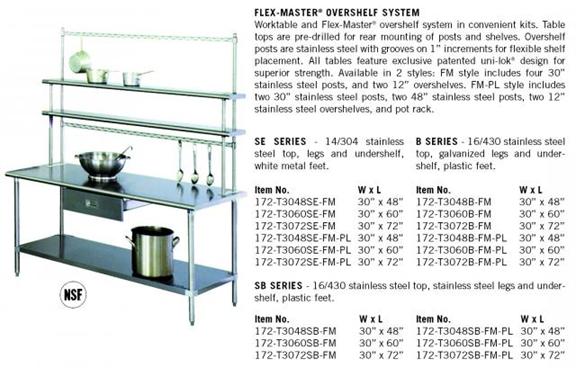
Figure 5 - Eagle Worktable
- Consider a grease trap from Zurn Industries, www.zurn.com. The website includes information on sizing grease traps using (a) sink dimensions or (b) using sink volumes.
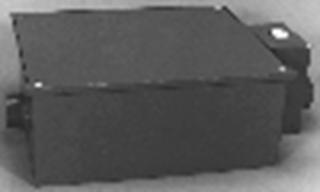
Figure 6 - Zurn Industries GT2701 Low Profile Grease Interceptor
- Consider a 6” or 8” floor drain.
- Consider a three compartment sink on the smaller side
- Consider an oven with a salamander broiler. “Whether it is the perfectly melted cheddar cheese on a hamburger or the browned cheese topping on a bowl of french onion soup, a specialized piece of kitchen equipment called a salamander broiler is probably responsible for it. Professional chefs use a salamander broiler for a number of reasons, from broiling fish to melting cheese to caramelizing sugar.” (Source: http://www.wisegeek.com/what-is-a-salamander-broiler.htm)
- Consider Internet search on “restaurant equipment.” Examples include www.rjh-equip.com, www.restaurantsource.com, etc.
- Consider Internet search on “restaurant range fire suppression.” Examples include www.acitydiscount.com, www.ansul.com, etc.
· Kitchenette, Loft Studio
- Locate the Dwyer kitchenette along the south wall, allowing room for four chairs and a small table of 3’ x 3’. This allows 3’ clearance between the table and kitchenette for working space, and 2’ 8” clearance between the table and walls at the narrowest location.
- Employ 4’ 6” long x 14” deep Metro Food Service Wire Frame Shelving, with wheels, as a mobile table along the north wall. Use casters to allow the shelving to be used for gallery events, and to allow removal for cleaning.
- Locate the washer/dryer in the kitchenette for use with the loft studio.
- Design Note: The kitchenette may be used as a Loft Studio kitchenette, or may be repurposed as an Art Manufactory crew break area.
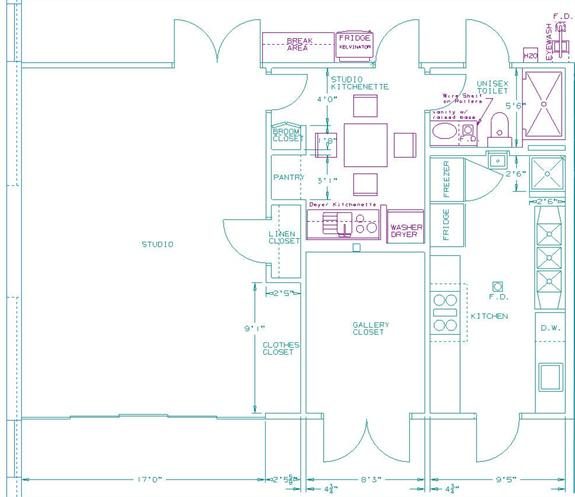
Figure 7 - Loft studio kitchenette with Dwyer kitchenette and washer/dryer along south wall
· Lighting, Interior, Fixtures
- Illuminate the Delmar Blvd. Interior Entrance and Stairway with vapor proof lighting (available in fluorescent and HPS)
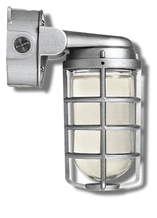
Figure 8 - Vapor Proof Lighting
· Walls, Art Gallery
- Roll CMU walls Sherwin-Williams City Loft, with a semi-gloss finish
- Roll plasterboard walls Sherwin-Williams City Loft, with a flat finish
· Wall, Delmar Boulevard
- Option 1: Restore and paint over only some plaster, leaving exposed masonry rough and unpainted
- Option 2: Consider a funky “rough finish” for the front office interior wall facing Delmar Blvd. by scraping off loose plaster, leaving the resulting “horrible finish”
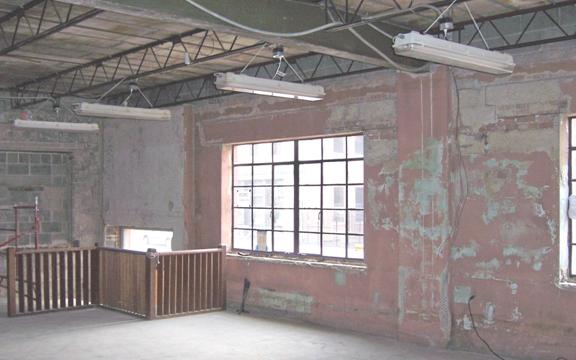
Figure 9 - Front Office Interior Wall facing Delmar Blvd.
· Walls, Shop, along Studio / Art Gallery
- Option 1: Consider Sherwin-Williams Naturel (light green) on plasterboard walls (Note: Naturel is same color as exterior doors)
- Option 2: Consider corrugated metal to protect walls and serve as a design accent
- Option 3: Consider funky colors from the Sherwin-Williams “Kinetic Contrast” pallet, such as Juneberry or Ablaze.
· Walls, Office
- Partial height walls 8’ high highlight the bar joist area and provide light. The offices don’t need soundproofing and thus allow for partial height walls.
- Option 1: Consider corrugated metal as a design accent.
· Water Cooler
- Option 1: Halsey Taylor OVL-II-SER-Q Bi-Level Two Level Accessible Water Cooler, $2,410.50, reference www.drinkingfountaindoctor.com
- Modular, electric refrigerated, bi-level wall-mounted water cooler designed to be easily accessible to physically challenged and able-bodied individuals. When properly installed,unit meets state and federal requirements as defined by the Americans with Disabilities Act. Unit is certified to NSF/ANSI 61 and meets requirements of the Safe Drinking Water Act. Unit provides 50° F water at 80° F inlet water and 90° F ambient.
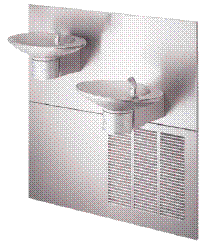
Figure 10 - Halsey Taylor OVL-II-SER-Q Bi-Level Two Level Water Cooler
· Option 2: Elkay EZSTLR8C ADA Barrier Free Bi-Level Water Cooler, $835.55, reference www.drinkingfountaindoctor.com
· No Lead Design-Water system free of lead-containing brass parts. Uses HFC-134a refrigerant. Barrier-Free ADA Design - Designed to meet adult or child accessibility standards when properly installed. Extra Deep Basin-minimizes splashing and its one-piece construction, with integrated drain, is vandal-resistant and easy to maintain. Front and Side Easy-Touch Controls-Minimal pressure is required for easy operation and increased durability. Flexi-Guard safety bubbler-Newly styled bubbler complements styling of cooler and is keyed into position to prevent rotation. Universal design makes for easy installation to existing plumbing systems. Colors - Light Gray Granite is standard. Stainless Steel available at additional cost.:
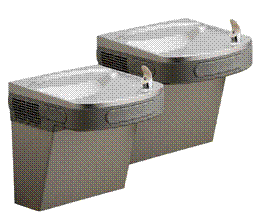
Figure 11 - Elkay EZSTLR8C ADA Barrier Free Bi-Level Water Cooler
· Stair Railing, Delmar Boulevard
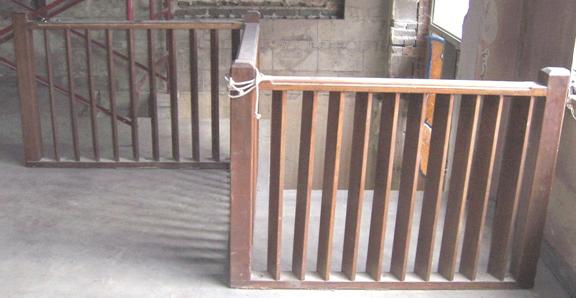
Figure 12 - Stairway Railing
- Stairway Railings – Railing required on each side of stairs, 34” above nosing each side, projecting 11” past nosing of top and bottom stairs.
- Option 1: Spray paint existing wood railing, for Delmar Blvd. entrance, a Sherwin-Williams coordinated color for an “outrageous” industrial look (Best option for now)
- Option 2: Floor to ceiling stainless steel wire rope railing, 4” O.C., secured taut with turnbuckles (Consider for a later date)
Exterior Specs
· Awnings
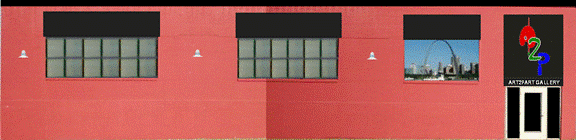
Figure 13 - Concept for Black Canvas Awnings along Delmar Blvd
- Option 1: Tall awning with a steep pitch over the entrance door, as suggested by architect Alvah Levine several years ago. Include a vinvyl Art2Part logo which is backlit at night.
- Option 2: Simple black canvas awnings over windows, which the City of Saint Louis has a matching 50/50 program for. (Note: Expected lifespan of a canvas awning is 5-10 years)
- Main awning:
· Put sides and a valance on the main awnings
· Reduce the size of the Art2Part logo to about 80%, or go with 8” borders
· Select backlit awning design. Illuminate with industrial HID or compact fluorescent light
- Window awnings:
· For a contemporary look, do not put sides or valances on the window awnings
· Use perforated aluminum sheet, anodized black. Perforated metal looks solid by day, appears illuminated by night, and is contemporary
· www.mcnichols.com, The Hole Catalog, is a source for perforated aluminum sheeting
· Door, Exterior, Accessible
- Any new accessible entrance door should contain a transom and side windows, similar to the front door fronting Delmar Boulevard (pictured).
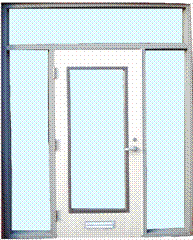
Figure 14 - Front Entrance to 2035 Delmar Blvd with Window above Transom
- The new art gallery lobby accessible entrance door will contain a transom and window with a transom and side window (pictured).
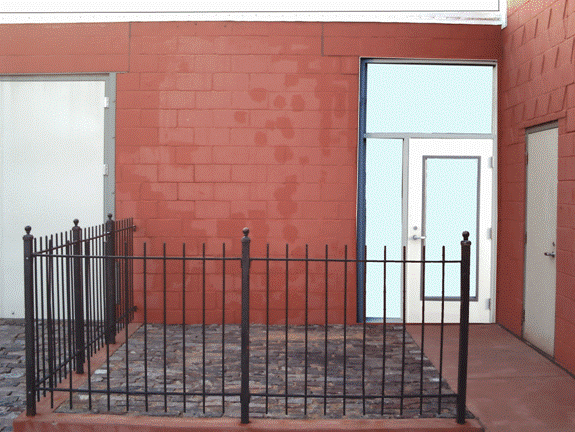
Figure 15 - Art Gallery Lobby Entrance with Window above Transom
· Glass, Exterior Door and Transom Window
- Select polished clear square wire glass (also known as Baroque Glass) for door glass (and interior borrowlights) to convey an industrial look. See Torstensen Glass Company for options at www.tglass.com.

Figure 16 – Square Polished Wire Reinforced Glass
· Lighting, Exterior, Fixtures
- Consider “Universe” style from Architectural Area Lighting. Website: www.aal.net
- Best size exterior lights are 16’ Saturn ring
- Locate the underside of the lights along the centerline of the window (heightwise)
- Design Note: Available with a compact fluorescent lamp which is wired to an auxiliary backup power supply for emergency lighting. Also, an auxiliary quartz lamp socket is available, which is wired to a separate emergency power circuit.
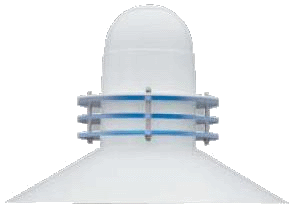
Figure 17 - Vapor Proof Lighting
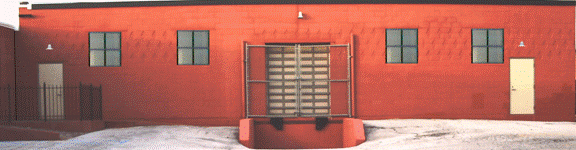
Figure 18 - Addition Front with Universe Style Exterior Lighting from Architectural Area Lighting
· Sign, Gallery
- Consider words ART2PART GALLERY (Horizontally, over valance above Delmar Blvd. door) and 2035 (Horizontally, across Delmar Blvd. door)
Figure 19 – Neon Gallery Sign and Universe Style Exterior Lighting from Architectural Area Lighting
- Incorporate neon lettering:
· Illuminate the words ART2PART GALLERY (Vertically in neon, reading from bottom to top) and 2035 DELMAR (Horizontally over transom)
· Red, Orange, Yellow, Green, Light Blue, Dark Blue, Indigo, Violet for ART2PART
· White for GALLERY and 2035 DELMAR
· Sign, Open, Traffic Light
- Employ a traffic light from Lights to Go, http://www.trafficlights.com/, visible from the front door window, signifying Open (Green), Hours By Appointment (Yellow), or Closed (Red). Light is shown as green, signifying “go” through the door

Figure 20 - Traffic Light Signifying Open (Green), Hours By Appointment (Yellow), or Closed (Red)
· Sidewalks, Fencing, and Landscaping
o Add tree wells in sidewalk
o Add 48” granite cobblestone tree strip
o Add perimeter street trees: Marshall Seedless Ash or Sunset Maple, coordinated with Forestry Dept, City of St. Louis
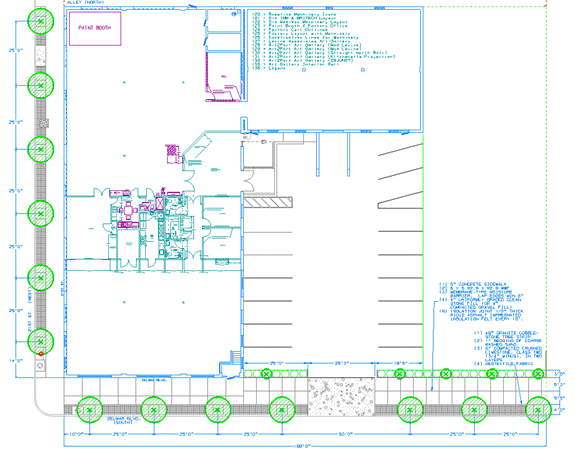
Figure 21 - Sidewalks, Fencing, and Landscaping
· Windows, Exterior
o The existing south office and east office window pane pattern is approximately 12” high x 16” wide. Original windows facing Delmar Blvd (smaller size) measure 5’ 2” x 4’ 4” inside, 5’ 3” x 4’ 5” outside (with ½” outside lip). A 2” spacer strip joined sections
· Replace three (3) existing south office windows facing Delmar Blvd.
· Replace two (2) in-filled east office windows facing the Arch
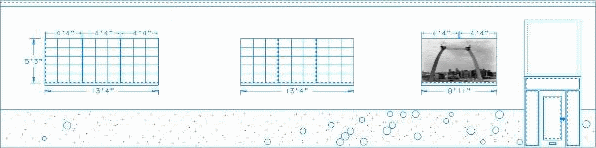
Figure 22 - Replace Existing Single Pane Steel Factory Windows
- The existing current east factory window pane pattern is approximately 16” high x 20” wide
· Replace four (4) in-filled east factory windows facing the Arch
· The new art gallery lobby accessible entrance door will contain a transom and window with a transom and side window

Figure 23 - Replace In-Filled Windows
- Aluminum Windows: Go with larger pane sizes, with contemporary layout of four (4) panes per window unit, if using aluminum windows. Consider inoperable storefront windows for gallery, relying on mechanical ventilation
· Awing Windows: Opening windows are hinged at top and project outward
- Steel Windows: Go with retro factory look, with original layout of 15 panes per window unit, if using steel windows
· Casement Windows – Opening windows open out to the side, like a door
- UV Protection: Windows need UV protection. “Natural light is an extremely intense source of energy and contains high levels of ultra-violet (UV) radiation. Most artworks are composed of organic materials making them especially vulnerable to UV wavelengths, the most damaging component of the light spectrum.” (Source: http://www.aucklandartgallery.govt.nz/services/conservation/caringforworks.asp)
- The 5’ 1 ½”W x 8’ 3”H east window facing the parking lot, currently blocked with CMUs, should be standardized to a 5’ 1 ½”W x 5’ 7”H window unit in harmony with the other windows on that wall
- Window requirements:
|
R.O. Height |
R.O. Width |
Quantity |
Comments |
|
5’ 3” |
4’ 4 ¾” |
2 |
1 Unit Nominal 5’ 2” x 4’ 4” |
|
5’ 3” |
13’ 4” |
2 |
3 Units Nominal 5’ 2” x 4’ 4” per unit + spacers |
|
5’ 3” |
8’ 11” |
1 |
2 Units Nominal 5’ 2” x 4’ 4” per unit + spacer |
|
5’ 7” |
5’ 1 ½” |
5 |
1 Unit R.O. 5’ 7” x 5’ 1 ½” |
|
5’ 7” |
10’ 5 ½” |
1 |
2 Units R.O. 5’ 7” x 5’ 1 ½” |
- Consider aluminum windows from these suppliers:
n Jen-Weld Windows and Doors (installed in The Tudor Building). Website: www.jeld-wen.com
n Win-Vent Architectural Windows (installed in Robbins Law Firm). Website: www.winventwindows.com
n Quaker Windows (installed in The Edge Lofts). Website: www.quakerwindows.com
· Windowsills
- Sills for three (3) Delmar Blvd. windows: use existing brick sills on the outside. Use marble or granite, possibly with a rough cut edge facing the gallery, cut in four (4) foot lengths, on the inside.
- Sills for six (6) in-filled east windows: use a soldier row of brick identical to the three (3) Delmar Blvd. windows on the outside. Use marble or granite, possibly with a rough cut edge facing the gallery, on the inside.
- Sills for windows in 8” infill: use a soldier row of brick identical to the 3’ wide x 1’ high windows.